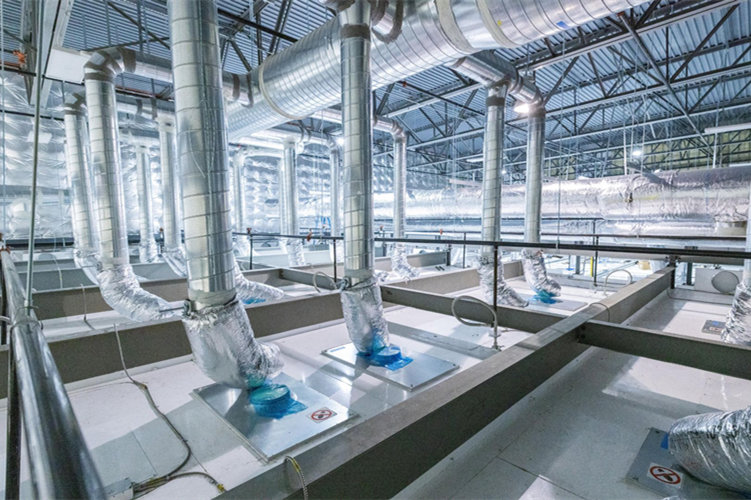
Core Differences in Connection Technology Between Clean Air Ducts and Ordinary Air Ducts
As the core carrier of ventilation and air conditioning systems, the connection technology of air ducts directly determines the tightness, stability of the system operation and the adaptability of the applicable scenarios. Due to the different core needs of their application scenarios, there are significant differences between clean air ducts and ordinary air ducts in terms of specifications and standards, operation procedures, material selection of connection technology. Especially in fields with strict clean grade requirements such as medicine, electronics, and food processing, these differences directly affect the cleanliness and safety of the production environment. Combining current industry standards and construction practices, this paper deeply analyzes the core differences between the two in connection technology, providing a reference for engineering construction and quality control.
The essence of the differences in connection technology between the two lies in the different core needs of the application scenarios: ordinary air ducts are mainly used for ventilation, exhaust or comfort air conditioning systems in ordinary buildings, with the core demand of ensuring smooth ventilation and firm connection, and the requirements for tightness and cleanliness are relatively loose; while clean air ducts mainly serve purification air conditioning systems and need to meet different levels of air cleanliness requirements. The connection technology needs to focus on solving problems such as sealing and anti-leakage, dust prevention, and pollution prevention. Each link must comply with strict industry standards to avoid dust, leakage and other hidden dangers caused by improper connection, which affect the stability of the clean environment.
I. Pre-connection Preparation: Differences in the Strictness of Environment and Substrate Treatment
The differences in connection technology are already prominent in the pre-preparation stage. The two have completely different requirements for the production environment and substrate treatment, which is also the basic guarantee for the subsequent connection quality.
The pre-connection preparation of ordinary air ducts is relatively simple, without special environmental control. The production site can be flexibly arranged according to the construction site conditions, without closed treatment. Before substrate processing, it is only necessary to simply remove obvious oil stains and debris on the surface, without professional cleaning and drying treatment. There are no special restrictions on processing tools; ordinary iron hammers, scribers, etc. can be used. The key is to ensure that the substrate has no obvious deformation or damage to meet the basic requirements for connection. According to the "Code for Construction of Ventilation and Air Conditioning Engineering" GB50738-2011, before the installation of ordinary air ducts, it is only necessary to check whether the air ducts have appearance defects such as deformation and scratches, and confirm that the specifications correspond to the installation position before conducting connection preparation.
The pre-connection preparation of clean air ducts is extremely strict, focusing on "pollution prevention and dust prevention" throughout the process. First of all, the production site must be relatively closed, and the ground must be paved with soft materials that are not easy to generate dust (such as rubber plates or wooden boards with a thickness of more than 5mm). Production personnel must wear soft-soled shoes when entering the site to avoid damaging the surface of the air duct substrate or generating dust pollution. Secondly, before substrate processing, neutral cleaning fluid must be used to remove surface oil stains and dust. The cleaning fluid must meet the requirements of no damage to the plate, no dust generation after drying, and no harm to the human body. After cleaning, it must be wiped dry and sealed in time to prevent secondary pollution. In addition, there are strict restrictions on processing tools. Non-metallic hammers such as wooden or rubber hammers must be used for seam joining to avoid damage to the galvanized layer of the substrate or deformation caused by iron tools. Red pencils must be used for marking, and sharp metal scribers are prohibited to prevent scratches on the plate surface leading to dust accumulation or damage. At the same time, clean air ducts need to reduce longitudinal joints and are strictly prohibited from setting transverse joints. The number of longitudinal joints on the bottom plate of rectangular air ducts must strictly follow the specification requirements to reduce connection hidden dangers from the source.
II. Core Connection Methods: Essential Differences in Connection Forms and Sealing Requirements
The connection method is the core of the differences between the two. Ordinary air ducts focus on "firm connection", while clean air ducts focus on "tight sealing + dust prevention". Therefore, there are clear distinctions in connection forms, sealing processes, and fastener selection.
(I) Differences in the Selection of Connection Forms
The connection forms of ordinary air ducts are relatively flexible, which can be flexibly selected according to the air duct size and pressure level without excessive restrictions. According to the specifications, metal rectangular air ducts can adopt angle steel flange connection, thin steel plate flange connection, C-shaped or S-shaped insert connection, standing bite connection, etc.; circular air ducts can adopt angle steel flange connection and core pipe connection; air ducts with side length less than or equal to 630mm can adopt S-shaped flat insert connection, and air ducts with side length less than or equal to 1250mm can adopt S-shaped standing insert connection. These connection forms are convenient for construction and low in cost, which can meet the needs of ordinary ventilation systems, and there is no need to strictly limit the insert or bite form. In addition, ordinary air ducts can be provided with reinforcement frames or reinforcement ribs according to needs to enhance the strength of the air ducts, and there is no need to consider the impact of the reinforcement structure on cleanliness during connection.
The connection forms of clean air ducts have strict prohibitive provisions, with the core of avoiding gaps, dust accumulation or damage to the substrate at the connection parts. According to the "Code for Construction and Quality Acceptance of Clean Rooms" GB51110-2015 and relevant specifications, when clean air ducts are connected without flanges, S-shaped inserts, right-angle inserts, combined angle inserts and other forms are strictly prohibited; for air ducts of purification systems with air cleanliness grade 1 to 5, snap-on bite forms and blind rivet riveting shall not be adopted to avoid gaps, dust accumulation or leakage at the riveting or bite parts. At the same time, no reinforcement frames or reinforcement ribs shall be set inside the clean air ducts to prevent the reinforcement structure from forming dust dead corners and affecting cleanliness; when the side length of the rectangular air duct is greater than 1000mm, thin steel plate flange air ducts without reinforcement measures shall not be adopted, and reinforcement methods meeting the requirements shall be adopted, and the reinforcement process shall not affect the connection sealing performance.
(II) Differences in the Strictness of Sealing Processes
The sealing requirements for ordinary air ducts are relatively loose, only needing to ensure basic tightness and prevent obvious air leakage. During connection, it is only necessary to place gaskets at the flange connections, and sealant can be simply applied to the bite seams and riveted seams according to needs, without fully sealing all seams; the gaskets can be ordinary rubber gaskets, asbestos gaskets, etc., with low requirements on the environmental protection and anti-aging properties of the material, as long as the connection is firm and there is no obvious leakage, and the position of the sealing surface does not need to be strictly limited.
The sealing process of clean air ducts is the core of connection, which needs to meet the requirements of "zero leakage and no dust accumulation", and every joint part must be strictly sealed. First of all, the sealing surface must be set on the positive pressure side of the air duct wall to ensure the sealing effect; the sealing material must be an environmentally friendly material that is not easy to age, not easy to generate dust, and does not contain harmful substances, so as to avoid pollution caused by the sealing material itself. Secondly, the bite seams, riveted seams of the air ducts and the four-corner gaps of the flange flanging must be tightly blocked by applying sealant or other sealing measures according to the design and cleanliness grade requirements, without any missing gaps; if the inner wall of the color-coated steel plate air duct has damaged coating, epoxy resin protection must be applied to prevent the substrate from rusting and generating dust. In addition, after the connection of clean air ducts, secondary cleaning and drying must be carried out in a relatively closed and clean space, and the air ducts can be sealed only after confirming no dust and no leakage, so as to ensure that there is no dust accumulation hidden danger at the connection parts and meet the requirements of different cleanliness grades, while ordinary air ducts do not need such secondary treatment.
(III) Differences in the Selection of Fasteners
The selection of fasteners for ordinary air ducts is relatively flexible. Bolts, nuts, washers and rivets can be made of ordinary materials, and only need to take anti-corrosion measures such as galvanizing in outdoor and humid environments; there is no strict limit on the rivet spacing. When connecting with core pipes, the rivet spacing should be 100mm to 120mm, which can ensure firm connection. Convenient fasteners such as blind rivets can be used to reduce construction costs.